
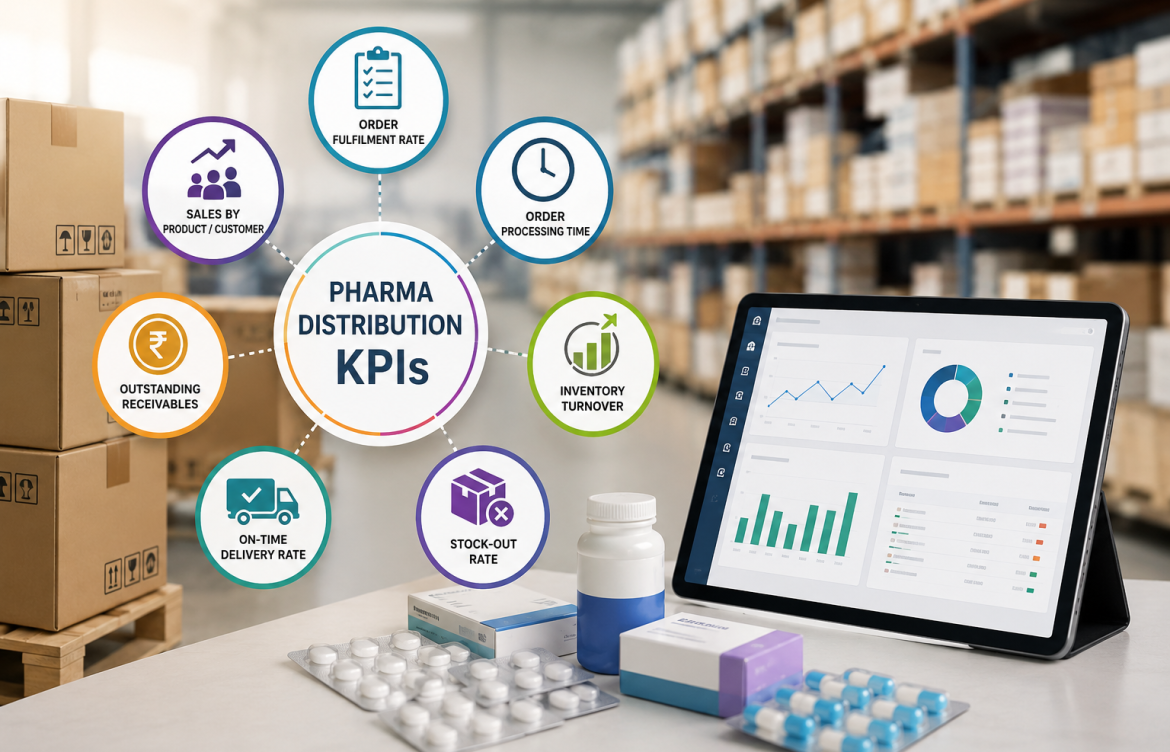
Pharma Distribution KPIs: 7 Metrics Every Distributor Should Track
Pharmaceutical distributors manage large inventories, customer orders, purchases, deliveries, and payments every day. Tracking the right pharma distribution KPIs helps distributors understand how efficiently their operations are performing and where improvements are needed.
Instead of looking only at sales, distributors can monitor key performance metrics related to orders, inventory, deliveries, receivables, and customer performance. These insights can help reduce operational delays, improve stock management, and support better business decisions.
Here are seven important pharma distribution KPIs every distributor should track.
Table of Contents
- Why Pharma Distribution KPIs Matter
- 7 KPIs Every Pharma Distributor Should Track
- How Pharma Distribution Software Helps
- Conclusion
- Frequently Asked Questions (FAQs)
Why Pharma Distribution KPIs Matter
KPIs give distributors a measurable way to evaluate business performance. They help identify operational problems that may not be visible from sales figures alone.
By regularly monitoring pharma distribution metrics, distributors can:
- Identify order processing delays
- Improve inventory planning
- Reduce stock-outs and excess inventory
- Monitor delivery performance
- Track outstanding payments
- Identify high-performing products and customers
- Make better data-driven decisions
7 KPIs Every Pharma Distributor Should Track
1. Order Fulfilment Rate
Order fulfilment rate measures the percentage of customer orders that are completed correctly and within the expected timeframe.
Formula:
Order Fulfilment Rate = Completed Orders ÷ Total Orders × 100
A higher fulfilment rate generally indicates better inventory availability and order processing.
Distributors should monitor this KPI regularly to identify issues such as unavailable products, incorrect orders, or delays in processing.
2. Order Processing Time
Order processing time measures how long it takes to process an order from the time it is received until it is ready for dispatch.
Long processing times can delay deliveries and affect customer satisfaction.
Distributors can monitor this KPI to identify bottlenecks in order entry, stock verification, picking, packing, or dispatch processes.
3. Inventory Turnover
Inventory turnover shows how efficiently inventory is being sold and replenished during a specific period.
Formula:
Inventory Turnover = Cost of Goods Sold ÷ Average Inventory
A healthy inventory turnover rate can indicate that stock is moving efficiently. Very low turnover may indicate excess or slow-moving inventory, while unusually high turnover may require distributors to review replenishment levels.
4. Stock-Out Rate
Stock-out rate measures how frequently products are unavailable when customers need them.
Frequent stock-outs can lead to missed sales and dissatisfied customers. This is particularly important for pharmaceutical distributors because retailers may need products consistently to meet customer demand.
Monitoring stock-out rates can help distributors identify products that require better forecasting, reorder planning, or inventory control.
5. On-Time Delivery Rate
On-time delivery rate measures the percentage of customer orders delivered within the promised timeframe.
Formula:
On-Time Delivery Rate = Orders Delivered on Time ÷ Total Delivered Orders × 100
Consistent delivery performance can help distributors maintain stronger relationships with retailers, pharmacies, hospitals, and other customers.
If the rate decreases, distributors can investigate issues related to order processing, warehouse operations, transportation, or route planning.
6. Outstanding Receivables
Outstanding receivables show the amount of money customers still owe the distributor.
Monitoring receivables helps distributors understand their cash-flow position and identify overdue customer accounts.
Regular tracking can help businesses follow up on pending payments, manage credit effectively, and reduce the risk of delayed collections.
7. Sales by Product or Customer
Analysing sales by product, customer, territory, or period helps distributors understand where revenue is coming from.
This KPI can help identify:
- High-performing products
- Slow-moving products
- High-value customers
- Low-performing territories
- Changes in sales trends
These insights can support better sales planning, inventory decisions, and customer management.
How Pharma Distribution Software Helps
Tracking pharma distribution KPIs manually can become difficult when order, inventory, sales, customer, and payment information is spread across different systems or maintained through spreadsheets.
Pharma distribution software can bring important business information together and provide reports that help distributors monitor performance more efficiently.
With the right system, distributors can gain better visibility into areas such as:
- Sales and order performance
- Inventory levels and movement
- Customer transactions
- Outstanding receivables
- Product performance
- Business reports
PharmAssist is designed to help pharmaceutical distributors manage their business operations with better visibility and control. By bringing key distribution activities into one system, it can help businesses access relevant information and make faster operational decisions.
Conclusion
Tracking the right pharma distribution KPIs gives distributors a clearer understanding of their operational and financial performance. Metrics such as order fulfilment, order processing time, inventory turnover, stock-outs, delivery performance, receivables, and sales performance can help identify areas that need attention.
Regular KPI monitoring, combined with effective processes and suitable pharma distribution software, can help distributors improve efficiency, manage inventory better, strengthen customer service, and make more informed business decisions.
Frequently Asked Questions (FAQs)
What are pharma distribution KPIs?
Pharma distribution KPIs are measurable performance indicators used to evaluate the efficiency, operational performance, and financial health of pharmaceutical distribution businesses.
Which KPI is most important for a pharma distributor?
There is no single KPI that is most important for every distributor. Order fulfilment, inventory turnover, stock-out rate, delivery performance, and receivables should be monitored together to get a broader view of business performance.
How can distributors improve their KPIs?
Distributors can improve performance by regularly reviewing KPI data, reducing manual processes, improving inventory planning, monitoring order and delivery performance, and using integrated distribution management software.
Can software help track pharma distribution KPIs?
Yes. Pharma distribution software can centralize operational data and generate reports that help distributors monitor sales, inventory, orders, customers, receivables, and other important performance metrics.