
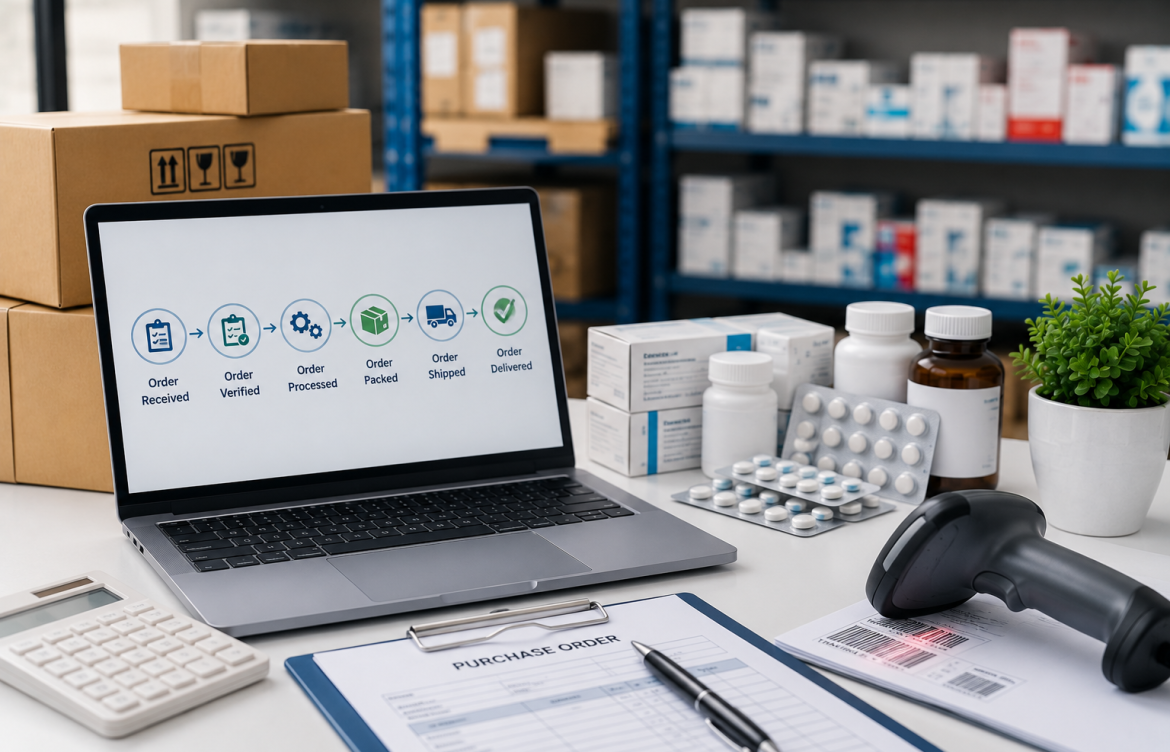
Pharmaceutical Order Management Process: A Complete Guide
The pharmaceutical order management process is one of the biggest challenges for distributors and wholesalers. Every day, businesses handle multiple customer orders, monitor inventory, generate invoices, dispatch medicines, and manage returns. When these processes rely on manual methods or disconnected systems, delays and errors become difficult to avoid.
A well-structured pharmaceutical order management process helps businesses improve operational efficiency, reduce billing mistakes, maintain accurate inventory, and deliver medicines on time. As the pharmaceutical industry continues to grow, digital order management has become an essential part of running a successful distribution business.
In this guide, you’ll learn what pharmaceutical order management is, why it matters, the common challenges businesses face, and how digital solutions can simplify the entire workflow.
Table of Contents
- What Is Pharmaceutical Order Management?
- Why Is Pharmaceutical Order Management Important?
- Common Challenges in Manual Order Management
- Benefits of a Digital Order Management Process
- Why Pharma Businesses Are Moving Towards Digital Systems
- How PharmAssist Helps Streamline Order Management
- In Short
- Frequently Asked Questions
What Is Pharmaceutical Order Management?
Pharmaceutical order management refers to the complete process of receiving, processing, tracking, and fulfilling medicine orders. It includes everything from order placement and inventory verification to billing, dispatch, delivery, and payment tracking.
An effective order management system connects different business operations into a single workflow, ensuring that medicines reach customers accurately and on time.
A typical pharmaceutical order management process includes:
- Receiving customer orders
- Checking stock availability
- Processing invoices
- Allocating inventory
- Planning dispatches
- Tracking deliveries
- Managing returns and replacements
- Recording payments
- Generating reports
When managed efficiently, this process improves both customer satisfaction and business productivity.
Why Is Pharmaceutical Order Management Important?
The pharmaceutical industry depends on accuracy, speed, and compliance. Even small mistakes can lead to delayed deliveries, incorrect billing, or stock shortages.
An efficient order management process helps businesses:
- Process orders faster
- Improve inventory visibility
- Reduce billing errors
- Track every order accurately
- Deliver medicines on time
- Improve customer satisfaction
- Support business growth
As order volumes increase, businesses need systems that can handle operations efficiently without increasing manual workload.
Common Challenges in Manual Order Management
Many pharmaceutical businesses still depend on spreadsheets, paper records, or multiple disconnected software applications. This creates several operational challenges.
Delayed Order Processing
Manual data entry and approvals slow down order fulfillment, affecting delivery timelines.
Inventory Mismatches
Without real-time stock visibility, businesses may accept orders for products that are unavailable.
Billing Errors
Manual billing can result in incorrect pricing, GST mistakes, or quantity mismatches.
Limited Order Tracking
It becomes difficult to know whether an order is pending, packed, dispatched, or delivered.
Complex Returns Management
Handling expired medicines, replacements, and credit notes manually requires additional time and effort.
Lack of Business Insights
Preparing sales reports and inventory reports manually delays decision-making.
Benefits of a Digital Order Management Process
Digital order management simplifies day-to-day operations while improving overall business performance.
Some of the major benefits include:
- Faster order processing
- Real-time inventory updates
- Better stock visibility
- Automated billing
- Batch-wise inventory tracking
- Reduced manual work
- Improved order accuracy
- Faster dispatch planning
- Better reporting
- Improved customer experience
By automating repetitive tasks, businesses can focus more on customer service and business growth.
Effective order management also helps reduce inventory shortages. Read our guide on how to reduce pharmacy stockouts to learn practical strategies for maintaining optimal inventory levels.
Why Pharma Businesses Are Moving Towards Digital Systems
Customer expectations are changing. Businesses are expected to deliver medicines quickly while maintaining complete accuracy.
Digital systems connect multiple business functions into one platform, including:
- Purchasing
- Sales
- Inventory management
- Finance
- Delivery tracking
- Reporting
Businesses looking to improve inventory control and operational efficiency can also explore how a distribution management system supports pharmaceutical distributors.
C-Square Pro Tip: Based on our experience working with pharmaceutical distributors across India, businesses that digitize their order management process often improve operational efficiency, reduce manual errors, and gain better control over inventory and customer service.
How PharmAssist Helps Streamline Order Management
PharmAssist is C-Square’s pharmaceutical distribution ERP designed to simplify end-to-end order management for distributors and wholesalers.
With PharmAssist, businesses can manage:
- Purchase and sales operations
- Batch-wise inventory
- GST-compliant billing
- Credit and debit notes
- Receipt management
- Rack transfers
- Replacement processing
- Reverse supply chain activities
- Business analytics and reports
By connecting multiple operational processes into one platform, PharmAssist helps businesses improve efficiency, reduce manual work, and make faster business decisions.
In Short
An efficient pharmaceutical order management process is essential for maintaining inventory accuracy, delivering medicines on time, and improving customer satisfaction.
As pharmaceutical businesses continue to grow, manual order processing becomes increasingly difficult to manage. Digital ERP solutions help automate operations, improve visibility, and support long-term business growth.
Businesses looking to improve operational efficiency should consider adopting a centralized order management system that simplifies every stage of the pharmaceutical distribution process.
Frequently Asked Questions
1. What is pharmaceutical order management?
It is the process of receiving, processing, tracking, and fulfilling medicine orders while managing inventory, billing, dispatch, and payments efficiently.
2. Why is digital order management important?
Digital order management reduces manual errors, improves inventory visibility, speeds up order processing, and enhances customer satisfaction.
3. What are the biggest challenges in manual pharmaceutical order management?
Common challenges include billing errors, delayed order processing, inventory mismatches, limited tracking, and manual reporting.
4. How can ERP software improve pharmaceutical distribution?
ERP software integrates purchasing, inventory, billing, finance, and reporting into one system, making business operations faster and more accurate.
5. How does PharmAssist support pharmaceutical distributors?
PharmAssist helps distributors manage orders, inventory, billing, returns, reporting, and other critical business operations from a centralized platform.