
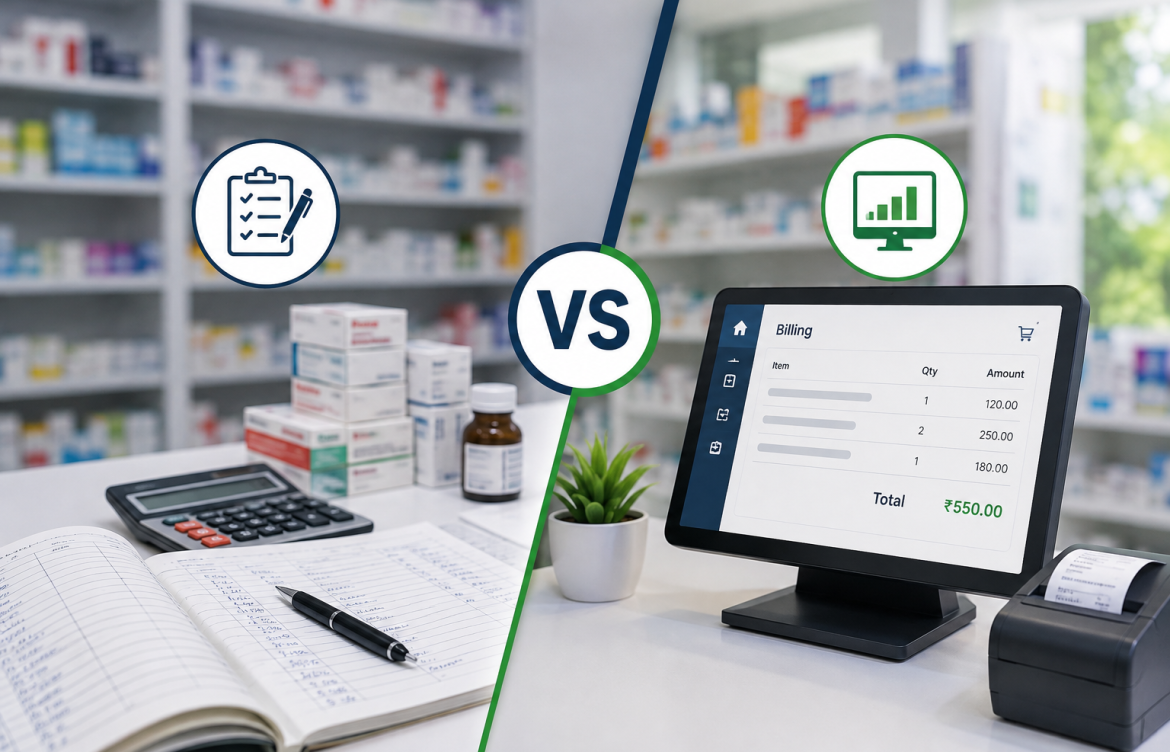
Pharmacy Billing Software vs Manual Billing
Running a retail pharmacy involves handling billing, inventory, medicine expiry, customer purchases, and daily sales. While many pharmacies still use manual billing, pharmacy billing software can make these tasks faster and easier to manage.
But which option is better for a retail pharmacy?
Let’s compare pharmacy billing software vs manual billing and understand the key differences.
Table of Contents
- What Is Manual Billing?
- What Is Pharmacy Billing Software?
- Pharmacy Billing Software vs Manual Billing
- Faster Billing
- Better Inventory Management
- Easier Expiry Management
- Reduced Billing Errors
- Quick Sales Reports
- Less Paperwork
- Is Manual Billing Still Useful?
- Which Is Better for Retail Pharmacies?
- Conclusion
- Frequently Asked Questions
What Is Manual Billing?
Manual billing involves preparing customer bills using handwritten invoices, calculators, spreadsheets, or basic billing methods.
It may work for a small pharmacy with limited transactions. However, as the number of customers and products increases, manual billing can become time-consuming.
Common challenges include:
- Manual calculations
- More chances of billing errors
- Difficulty updating stock
- Time-consuming record keeping
- Manual expiry checking
- Limited sales reports
- Increased paperwork
What Is Pharmacy Billing Software?
Pharmacy billing software is a digital solution designed to simplify billing and other day-to-day pharmacy operations.
It can help pharmacies manage billing, inventory, medicine expiry, GST calculations, sales records, and reports from a centralized system.
Instead of maintaining separate records, pharmacy staff can manage important information digitally.
Pharmacy Billing Software vs Manual Billing
| Feature | Manual Billing | Pharmacy Billing Software |
|---|---|---|
| Bill Creation | Manual | Faster and automated |
| Calculations | Manual | Automatic |
| Inventory Updates | Manual | Automated |
| Expiry Tracking | Manual | Easier to track |
| GST Calculation | Manual | Automated |
| Sales Reports | Time-consuming | Quick |
| Stock Visibility | Limited | Better |
| Record Keeping | Paper/Spreadsheets | Digital |
| Billing Accuracy | Higher risk of errors | Reduced errors |
Faster Billing
Manual billing requires staff to calculate quantities, prices, discounts, and totals.
Pharmacy billing software automates these calculations and helps staff create bills faster. This can reduce customer waiting time, especially during busy hours.
Better Inventory Management
Keeping track of medicine stock manually can be difficult.
With pharmacy billing software, stock can be updated automatically when a sale is completed. Pharmacy owners can get better visibility into available stock and identify products that need to be reordered.
Easier Expiry Management
Medicine expiry management is an important part of pharmacy operations.
Checking expiry dates manually can take significant time, particularly when managing a large number of products. Pharmacy software can help track expiry dates and provide alerts for medicines approaching expiry.
Reduced Billing Errors
Manual calculations can lead to mistakes in quantities, discounts, taxes, or total amounts.
Automated billing reduces repetitive calculations and helps improve billing accuracy.
Quick Sales Reports
With manual records, preparing sales and stock reports can take considerable time.
Pharmacy billing software can provide reports on sales, purchases, inventory, GST, and product performance, helping pharmacy owners understand their business more easily.
Less Paperwork
Manual billing often requires maintaining physical bills and registers.
Digital billing helps reduce paperwork and makes transaction information easier to store and retrieve when required.
Is Manual Billing Still Useful?
Manual billing can be suitable for very small pharmacies with limited customers and a small inventory.
However, as the pharmacy grows, managing billing, stock, expiry dates, and reports manually can become increasingly difficult.
Pharmacies with higher transaction volumes can benefit from moving to a digital billing system.
Which Is Better for Retail Pharmacies?
For a small pharmacy with very few transactions, manual billing may seem simple.
But for growing retail pharmacies, pharmacy billing software is generally the better option because it can improve billing speed, reduce repetitive work, simplify inventory management, and provide better business visibility.
The right solution ultimately depends on the pharmacy’s size, transaction volume, inventory, and operational requirements.
Conclusion
Manual billing may be easy to start with, but it becomes harder to manage as a retail pharmacy grows.
Pharmacy billing software can help automate billing, improve inventory control, simplify expiry tracking, reduce paperwork, and provide useful business reports.
For retail pharmacies looking to improve efficiency and manage daily operations more effectively, moving from manual billing to pharmacy billing software can be a practical step toward smarter pharmacy management.
Frequently Asked Questions
Is pharmacy billing software better than manual billing?
For growing retail pharmacies, pharmacy billing software can provide faster billing, better inventory management, easier reporting, and improved operational efficiency.
Can pharmacy billing software track medicine expiry?
Yes, pharmacy software can help track expiry dates and provide alerts for medicines approaching expiry, depending on the features available in the system.
Does pharmacy billing software reduce billing errors?
Automated calculations can reduce common errors associated with manual calculations and data entry.
When should a pharmacy switch to billing software?
A pharmacy should consider switching when manual billing becomes time-consuming or when managing inventory, expiry dates, sales, and reports becomes difficult.