
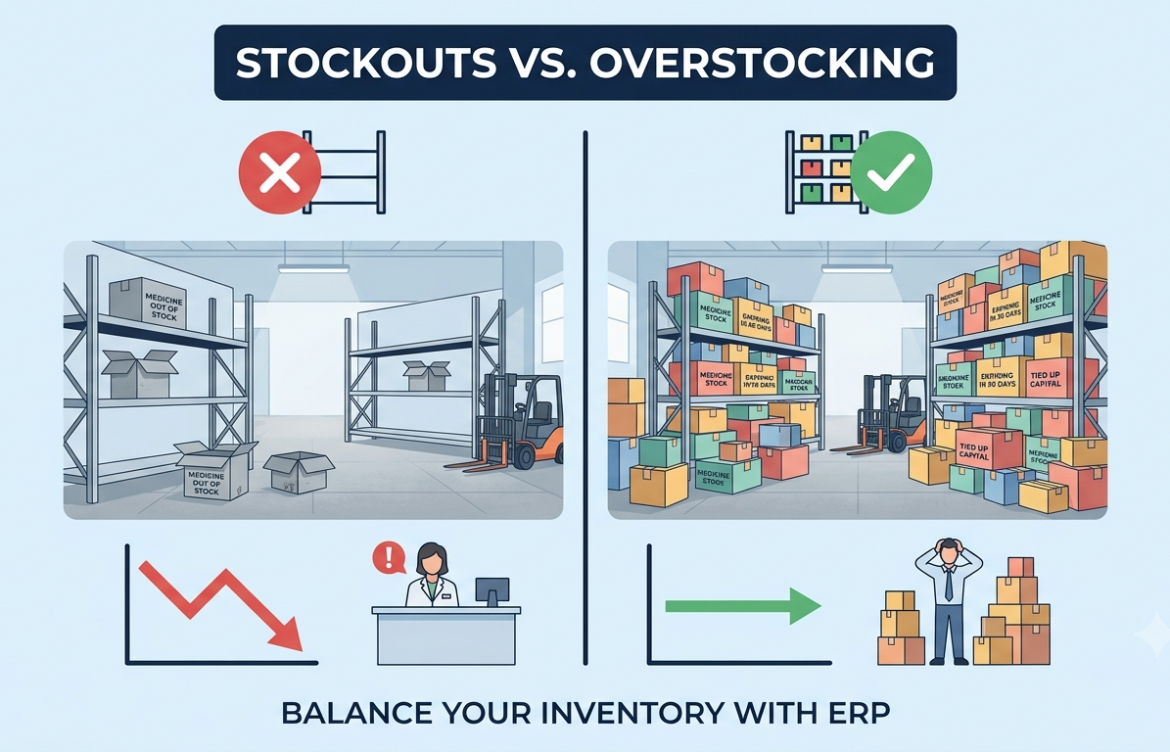
Preventing Stockouts vs Overstocking in Pharma Distribution
For pharmaceutical distributors, balance sheet health depends on precise inventory control. Operating between strict manufacturer lead times and immediate pharmacy supply demands creates a persistent operational challenge: preventing revenue-killing stockouts without locking up working capital in overstocked inventory.
Holding excess stock leads to tied-up capital, elevated holding costs, and increased risk of batch expiration. Conversely, stockouts result in lost sales orders, dissatisfied retail pharmacy clients, and damaged distribution relationships. Achieving operational balance requires shifting from reactive manual stock checks to automated, data-driven supply chain management using specialized pharma inventory optimization software like PharmAssist ERP.
Table of Contents
- The Real Cost of Stockouts and Overstocking in Pharma Wholesale
- Key Metrics for Pharma Inventory Optimization
- Strategies to Eliminate Stockouts and Excess Stock
- How PharmAssist ERP Automates Inventory Control
- Conclusion
- Frequently Asked Questions (FAQs)
The Real Cost of Stockouts and Overstocking in Pharma Wholesale
Mismanaged inventory exerts severe financial strain on wholesale operations at both ends of the spectrum:
- The Financial Impact of Stockouts: When high-demand acute or chronic medicines are out of stock, retail pharmacies immediately pivot to secondary distributors. This results in immediate order cancellation, loss of customer lifetime value, and reduced distributor reliability scores.
- The Operational Risk of Overstocking: Storing excess inventory increases warehouse holding costs, slows down stock rotation, and drastically elevates the risk of medicine expiry—a primary profit leak that retail outlets actively avoid using batch tracking tools like SmartRx.
Key Metrics for Pharma Inventory Optimization
To maintain optimal inventory levels, pharmaceutical wholesalers track three critical data-driven parameters:
1. Reorder Point (ROP)
The minimum inventory threshold that automatically triggers a purchase order. It accounts for daily sales velocity and manufacturer lead time.
2. Safety Stock Level
A buffer inventory maintained to absorb unpredictable demand spikes or supply chain delays from pharmaceutical manufacturers.
3. Inventory Turnover Ratio (ITR)
An efficiency metric calculating how many times warehouse inventory is sold and replaced over a specific period, measuring capital liquidity.
Strategies to Eliminate Stockouts and Excess Stock
1. Automated Min-Max Reordering
Manual reordering relies on guesswork. Modern ERP systems dynamically calculate minimum and maximum stock levels per SKU based on historical consumption trends, eliminating human forecasting errors.
2. ABC & VED Inventory Categorization
Categorize warehouse stock using dual-matrix analysis:
- ABC Analysis: Segregates inventory by value (A = High value/revenue generators, B = Moderate value, C = Low value).
- VED Analysis: Segregates items by clinical urgency (Vital, Essential, Desirable) to ensure life-saving medicines are never out of stock.
3. Real-Time Demand Integration with Field Sales
Connecting warehouse inventory with field sales representatives using mobile order tools like SFA360 ensures incoming demand is captured and synced with the central ERP instantly, providing clear visibility into upcoming order volumes.
How PharmAssist ERP Automates Inventory Control
Managing thousands of SKUs across multiple manufacturers requires real-time automation. PharmAssist ERP equips pharmaceutical distributors with intelligent inventory control tools built specifically for the supply chain:
- Dynamic Stock Level Calculations: Automatically adjusts reorder thresholds based on seasonal demand fluctuations and lead-time analytics.
- Automated Purchase Order Generation: Drafts POs to manufacturers as soon as stock hits safety thresholds, reducing manual intervention.
- Integrated Credit & Batch Management: Prevents over-purchasing while keeping capital flowing through automated systems like wholesale credit limit and scheme management.
Conclusion
Balancing inventory in pharmaceutical distribution is no longer about manual counting; it requires algorithmic forecasting. By replacing guesswork with automated min-max calculations, safety stock buffers, and intelligent ERP tracking via PharmAssist, distributors successfully eliminate stockout risks while keeping working capital fluid and free from excess stock.
Frequently Asked Questions (FAQs)
Q1. What causes stockouts in pharmaceutical distribution?
Stockouts are primarily caused by unrecorded sales velocity spikes, manual purchase order delays, inaccurate inventory counts, unexpected manufacturer lead times, and lack of real-time visibility into field sales orders.
Q2. How is safety stock calculated in pharma wholesale?
Safety stock is calculated using the formula: (Maximum Daily Sales × Maximum Lead Time) − (Average Daily Sales × Average Lead Time). Intelligent pharma ERP software automates this calculation continuously for every SKU.
Q3. What is the ideal Inventory Turnover Ratio for a pharma distributor?
While target ratios vary based on product mix (acute vs. chronic), high-performing pharmaceutical distributors typically target an inventory turnover ratio between 8 and 12 times per year, ensuring high liquidity and minimal expiry risk.
Q4. How does PharmAssist ERP prevent overstocking?
PharmAssist ERP analyzes historical sales trends, vendor lead times, and current stock-on-hand to automatically set maximum stock caps. It alerts procurement managers if a new purchase order exceeds optimal holding limits.